
On this page
Calculate your pool volume first
Every chemical treatment starts with knowing the water volume. Enter the dimensions:
Pool volume calculator (cubic meters and liters)
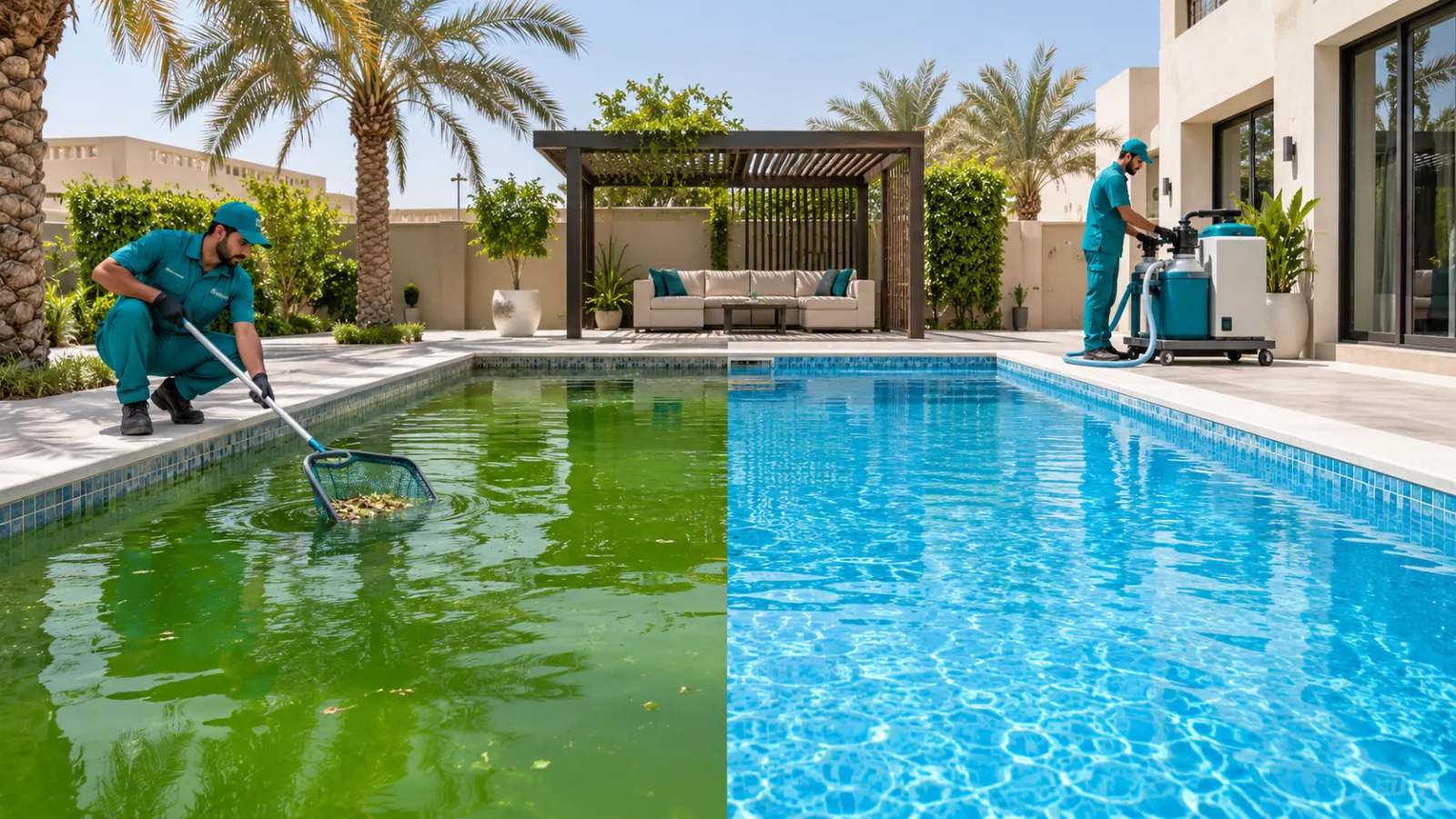
Why did the pool water turn green? Shades of green
| Condition | What you see | What it means | Expected treatment time |
|---|---|---|---|
| Light green | You can see the floor clearly; the water has a green tint | Early algae with low chlorine | Usually short |
| Medium green | The floor is not clear; slimy walls | Widespread algae and the filtration cannot keep up | Longer, with repeated filter backwashing |
| Dark green / swamp | You cannot see the floor; there is a smell | A pool neglected for some time | Longer, and a partial drain may need assessing |
Actual times vary with volume and filter condition.
Treatment steps as the technician carries them out
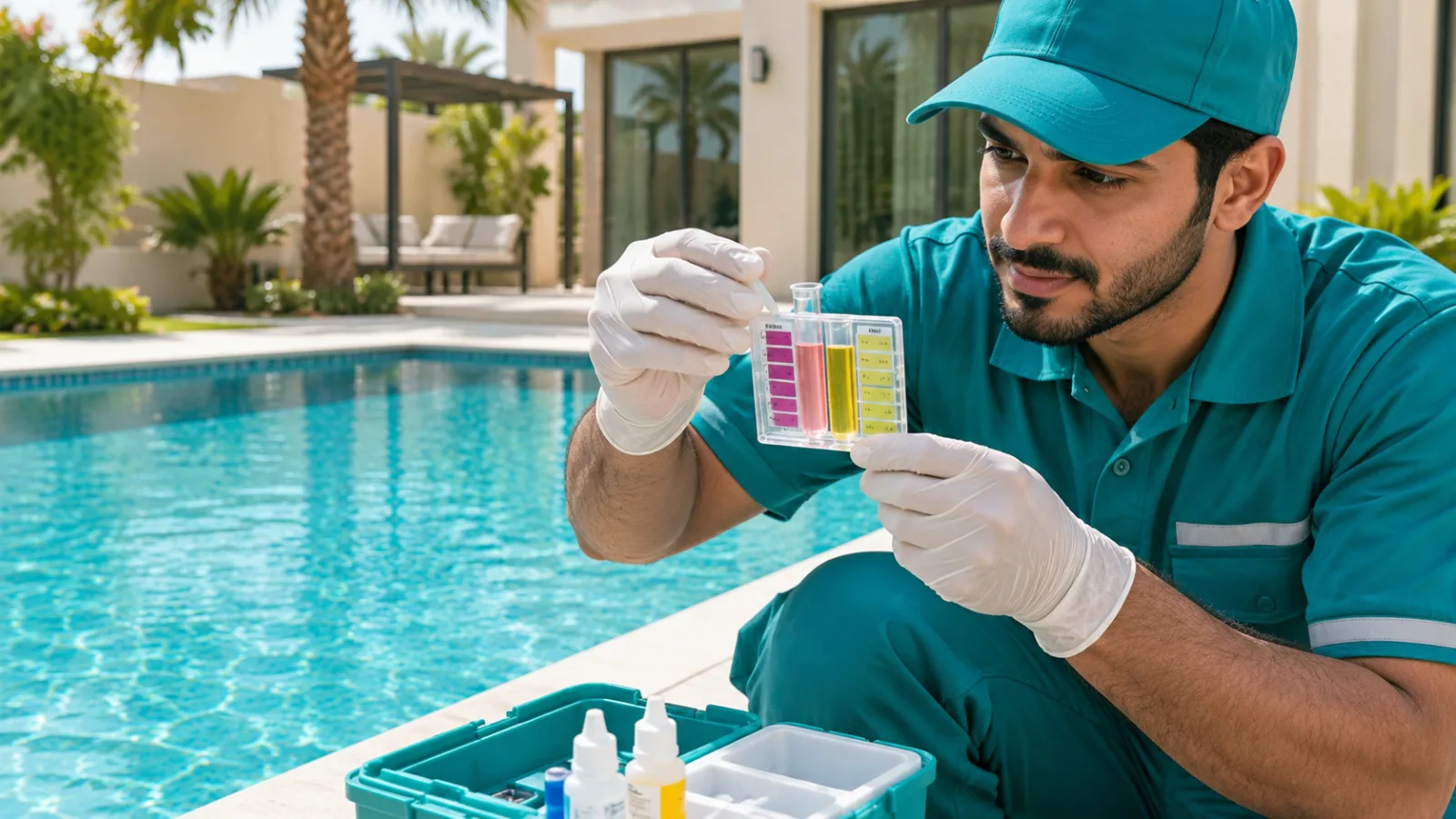
- Testing: free and total chlorine, pH, alkalinity.
- Checking circulation and the filter: is the pump drawing well? Is the filter pressure high? Is the filter sand worn out?
- Mechanical cleaning: brushing the walls, steps and corners to break up the algae layer, and cleaning the baskets.
- Adjusting the pH first, because chlorine loses much of its effectiveness when the pH is high.
- Shock treatment at the right dose for the volume and condition, usually in the evening because sunlight uses up chlorine.
- Running the filtration longer and backwashing according to the pressure.
- Vacuuming the floor after the dead algae settles.
- Re-testing before swimming is allowed.
Common pool water chemistry ranges
| Measurement | Common range for home pools | If it is out of range |
|---|---|---|
| pH | About 7.2 – 7.8 | High pH weakens chlorine and clouds the water; low pH irritates the eyes and affects equipment |
| Free chlorine | About 1 – 3 ppm | Low levels allow algae and bacteria to grow |
| Total alkalinity | About 80 – 120 ppm | Keeps the pH stable; an imbalance makes it fluctuate |
Cloudy water: not all cloudiness is algae
- White cloudiness with good chlorine: usually weak filtration or high pH and alkalinity.
- Cloudiness after adding chlorine: a reaction with hard water or high pH.
- Cloudiness after storms: fine dust that needs long filtration and backwashing.
If the filter is the cause, go to pump and filter maintenance.
- Do not mix different chemicals (especially different types of chlorine, or chlorine with acids); mixing can cause a dangerous reaction or toxic gases.
- Add the chemical to the water, never the water to the chemical.
- Store chemicals in a dry, cool, closed place away from children and sunlight.
- Wear gloves and safety goggles, and do not breathe in the fumes.
- No one should swim after a shock treatment until testing shows the chlorine is back in its safe range.
- If swallowed or inhaled, or in case of eye contact, seek medical help immediately.
Pricing
Water treatment is priced by pool volume, severity of the condition and the number of visits needed: Based on inspection. See how we price. To stop the problem coming back, consider a regular visit contract.
Frequently asked questions about pool water treatment
How do I get clear pool water?
Clear water comes from three things together: chlorine within range, balanced pH, and enough filtration every day. If any one of them is off, the water turns cloudy however many products you add.
What is the best algaecide for a pool?
Algaecide is a helper, not a substitute for chlorine, brushing and filtration. The type is chosen based on the kind of algae and the pool’s condition, and the key is preventing it from returning by keeping the chemistry balanced.
Should I drain a green pool completely?
Usually there is no need to drain it completely; treatment is enough in most cases. Draining is considered in very severe cases or if the water is hard or saturated with stabilizer, and it needs care so the pool structure is not damaged.
Is chlorine harmful during pregnancy or for children?
Pools with correctly balanced chlorine are normally used safely, but specific health conditions should be discussed with a doctor. What matters is that chlorine is within range and that no one swims straight after a shock treatment.
Contact Safwak
Send photos of the place or describe what you need on WhatsApp. We will arrange an inspection and explain how the price is calculated before any work starts.